Showing posts with label health. Show all posts

Tuesday, April 12, 2011

When the diagnosis comes... part one


With the diagnosis I've been given for my "Mounier-Kuhn Syndrome", I've become very aware that I may be absolutely living on borrowed time until the judge and jury sounds the gavel on the desktop (lung transplant or death). but for pure optimal mental health, it remains of utmost importance to press on with the most positive attitude I can muster, even on the most difficult days.

When I was first diagnosed, my wife and I both felt helpless given that the doctors did not even recognize what it was I was presenting to them, let alone the fact that there was nothing at all available on the world wide web for me to perform any sort of timeless personal research, in the hope of preparing myself for the future.


Exposing awareness to MKS for me, has become ultimately of huge importance, if only to offer another MKS patient camaraderie and support. 

The question becomes, not what I can do for myself having already lived for this long with my diagnosis, but how can we in turn can help another struggling with this difficult still mostly unknown diagnosis? 

Awareness. 

We believe that is the key for living with this rare diagnosis.

Yes! We've been working away, planning on bringing plenty of awareness to MKS.

To make others aware of the disease, to assist those who are diagnosed with it, and to support anyone in the medical field who might be searching high and low for answers to their medical questions. If we can help them in any possible way, we are willing to step up to the plate, as are others we've met throughout the world currently also living with MKS.

Awareness is most definitely key to coping, to understanding, to moving on, to taking even the smallest step along the long medical journey ahead!

Though I am NOT a professional in the perfect sense of the word by way of respiralogy or medical personnel, by having already lived with and through this disease, it has allowed me to become an true expert on my own health journey at the very least. I have lived through double the years all the doctors thought I would, surprising a whole host of specialists by being alive still today.

My own diagnosis was very difficult to come by, a medical puzzle for an entire team of doctors, internists, respiralogists, nephirologists, and even a world renowned pathologist. I was prepared for and bracing myself for a diagnosis similar to the intensity of a confirmed lung cancer, so not sure what was ailing me, I would have been satisfied with that, knowing what we were at least dealing with. A few specialists wondered about COPD, but none were ready for the breakthrough ahead for realizing such a rare diagnosis, penned on my hospital patient chart.


Fast forward a decade, and sadly "Mounier-Kuhn Syndrome" continues to be a very rare and often unacknowledged lung disease even in the best "respiratory lung" circles.

For instance, my wife made contact with the Canadian Lung Foundation to make an inquiry as to whether or not they could include MKS in their data base system on their website, creating a link to something offering more information on it. As usual to most of our inquiries of the past decade, this is the reply we got in return;


Hello,
 
Thank you very much for your comments to the Canadian Lung Association on Tracheobronchomegaly.
 
I am sorry to hear your husband has this disease, and I commend you for your efforts in explaining it and providing support to others.
 
I can understand your disappointment at not being able to find information on tracheobronchomegaly on the national Lung Association website, www.lung.ca.  The truth is, it takes a lot of resources to research, write, translate, verify and continuously update health information. The sheer number of lung diseases is staggering- there are major long-term lung diseases like asthma and COPD (emphysema and chronic bronchitis), infectious lung diseases, work-related lung diseases, lung cancers… it’s a huge range.
 
Sadly we do not have the staff and resources to provide information on every lung disease. This is regretful; I really wish we could do more. The reality is that will small staffs and budgets we just can’t get to everything we’d like.
 
I will note in our files that there has been a request for information on tracheobronchomegaly, and will share this with my supervisor.
 
You may also want to call the respiratory health educators at the Ontario Lung Association. You can reach them toll-free at 1-888-566-LUNG (5864)
or by e-mail at info@on.lung.ca .
 
I wish you and your husband all the best.
 
 
Regards,
 
Mary McNeill
Information Specialist / Documentaliste spécialisée
National Lung Health Framework / Cadre de travail national sur la santé pulmonaire
The Lung Association – National Office / L'Association pulmonaire - Bureau national
1750 Courtwood Crescent, Suite 300
Ottawa ON K2C 2B5


** For all newly diagnosed patients, stay tuned as I'll be offering some practical suggestions in the part two of this article, coming up soon. 


Friday, December 10, 2010

Spirometry - Pulmonary Lung Function testing (PFT)

Who should have a lung function test?

Spirometry machine used to perform a PFT

Spirometry is most common of the pulmonary function tests (PFT), measuring lung function, specifically measuring the amount of volume and/or speed flow of air that can be inhaled or exhaled.
Spirometry is an important tool to assist in accessing lung condition, lung health issues and lung function.
In the photos below;

One of the many pulmonary function tests I've endured to determine the complex lung health issues of my diagnosis of "Mounier-Kuhn syndrome". This time though, I was asked if a class of nurses could observe my testing. 

I hope they walked away with further information on the importance of this spirometer equipment, and never forget how they were enlightened about what in the world MKS is!

Who then should have a lung function test? 
(Hint; Watch the movie below, for you'll be surprised ....)


Friday, November 19, 2010

The importance of respiratory physiotherapy

We've been remiss for the past little while to post here, but assure you all will become much more active in the near future. We have much to share, and apologize if you've yet to hear back personally via emails, those too will be caught up very shortly. 

In the meantime, we'd like to share this brand new video clip produced by Dr. Roger Goldstein, the respiralogist in charge of the (cutting edge) respiratory physiotherapy program I attend twice weekly here in Toronto. Patients from all over Canada travel in the hope of being assisted here. 


Although this clip focuses on those with COPD, all those who attend the in or out patient program at Westpark Hospital actually represent many assorted and various lung diseases, and not just COPD. 

I spent seven weeks as an inpatient, living at this physiotherapy hospital almost two years ago now, the best thing to come my way since my diagnosis with "Mounier-Kuhn Syndrome" for sure! My wife jests with me often that it compares to the "Hotel California", because one can always get in but never leave. And I've never left, that's true. Even the staff there have informed me - I am theirs now (forever more), with at least one mandatory yearly inpatient refresher course to monitor my lung and overall health for continued care through both pre and/or post transplant.

My initial hospital exit pass from that seven week stay was only offered under the condition I promised to continue with three more months of twice weekly out patient sessions. These though have remained a constant necessity as the staff feel my case renders a longer and more continuous flow of monitored and charted health care. 

Here is where I admit, this hospital has steadily become a lifeline to me with care and support like no other, with staff (same as shown in the video who also care for me), and patients also suffering from lung disease who absolutely "get" what I'm also having to deal with. 

Thank you Dr. Goldstein for implementing this program, and for all other respiratory doctors across Canada who are bringing it to other cities in order to assist others with lung diseases. 


Thursday, October 14, 2010

Autumn; a time for colds and flu right around the corner now


Autumn...

In Autumn, there is beauty everywhere one looks. 

Mornings are crisp and cool, not so great for those suffering from lung disease. It hurts to suck in cold air, caution is necessary when breathing outdoors. 

This is the time of year when everyone seems to get a cold from the change of season, those very cold mornings and hot afternoons, when no one is really acclimatized just yet to the great temperature variations.

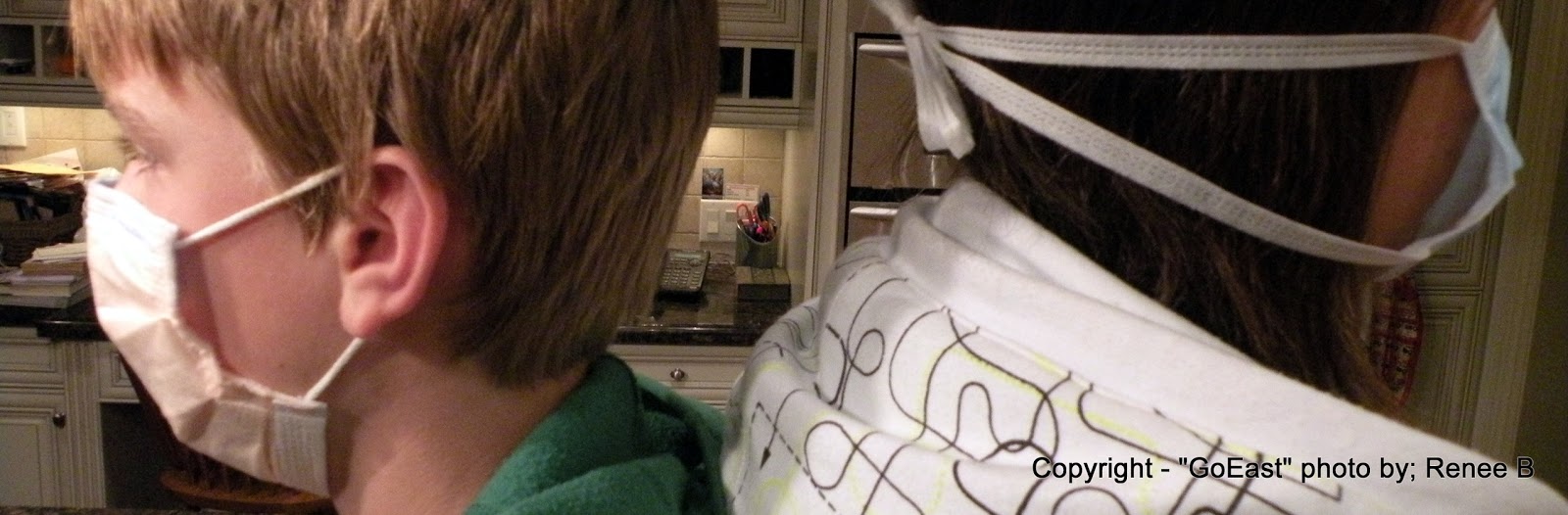
The flu shot clinics begin, and masks fast become the norm for people like us who have to protect ourselves from illnesses and the possibility of swift rolling lung infections that knock us over medically and can present very serious complications to our very lives. (And for those who have suppressed immune systems, or are extra sensitive to illness, please be very careful if you know someone who has recently received the flu mist, as it is still contagious for up to three weeks afterward.)

Simple protection in a home filled with children/teens becomes necessary, either for those who are well to avoid those who are ill, or to isolate the sickies from the rest of the family/friends. 

"Shoppers Drug Mart" in Canada is a large pharmacy store, one which stocks several types of surgical masks in their health section. 

At this time, we have two types in our home; super surgical masks with elastic side to wrap around the ears, or a lighter mask with double tie options. 

Everyone here seems to prefer the elastic around the ears, however the double ties are great too for those who prefer to avoid tension for any tenderness around the ears. 

The only draw back that we've seen so far is how easily the ties can rip off, or the feeling of clumsiness to get them tied up in the first place. I think when the tie backs are all used up, we'll resort to only have the elastic ones around here. 

If you are a mask user, which type would you prefer? Or can you recommend another type of surgical mask for those who require protection from sickies in their midst? Love to hear from you. :)